Scientists tracked 23,000 people’s sleep with smart rings for months, and the people with the most depression and anxiety had one sleep habit in common

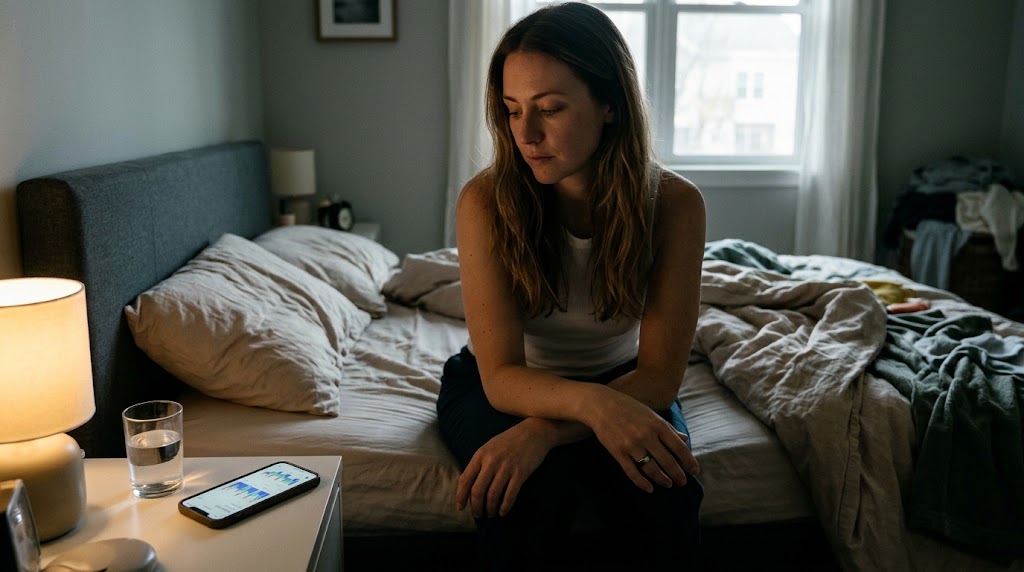
Most sleep advice focuses on how long you sleep and how well. Researchers at UC San Francisco and UC San Diego looked at something else: how consistent people’s sleep is from one day to the next. They analyzed data from about 23,000 adults who wore a smart ring that tracked when they fell asleep and woke up, for an average of 154 days each. Every month, participants also reported their symptoms of depression, anxiety and loneliness.
Less regular sleep went with worse mental health. People whose bedtimes and wake times shifted more from day to day reported more severe depression and anxiety, and those with elevated loneliness also had less regular sleep.
The team measured regularity with the Sleep Regularity Index, a score from 0 to 100 where higher means more consistent. People with no or few depressive symptoms averaged 84. Those with mild symptoms averaged 83, moderate 81, and severe 75. For anxiety, people with normal levels averaged 84, compared with 79 for those with severe anxiety.
What does that mean in real life? “Someone with an SRI of 84 might go to bed and wake up roughly an hour earlier or later than the previous day, on average,” said first author Severine Soltani. “For someone with an SRI of 75, that shift in sleep schedule might be closer to an hour and a half.”
“Regular sleep and wake time help keep circadian rhythms aligned,” said senior author Ashley Mason of UCSF. “Irregular sleep-wake timing may weaken circadian alignment, which is associated with depression and other mental health disorders.” Irregular schedules also shift the timing of light exposure, meals, exercise and social contact, all of which help set the body clock.
The second finding is about why months of data mattered. When the researchers looked at a single typical week, as many earlier studies did, the links were weaker. Over months of tracking, the association between irregular sleep and mental health became clearer.
Which comes first is still open. Irregular sleep could be a symptom of depression or anxiety rather than a cause. “Other longitudinal research provides some reason to think that irregular sleep may come first and contribute to later poor health, rather than being solely a consequence of it,” Mason said. Timing matters for the body in other ways too, from when you go to bed and weight loss to jolting awake as you fall asleep.
For anyone whose schedule swings between weekdays and weekends, the practical step is to keep bedtime and wake time within a similar window every day, including days off. It costs nothing, and the researchers say future trials should test whether it improves mental health. For people already struggling with depression or anxiety, effective treatments exist, as a recent comparison of antidepressants showed.
There are limits to what this shows. The study is observational, so it cannot prove that irregular sleep causes worse mental health. Sleep timing was estimated by a ring, not measured in a sleep lab, and mental health was self-reported. The participants were people who joined a wearable study, not a random sample. The study was funded partly by the US Department of Defense and Oura, which makes the ring, and two authors have consulted for Oura.
Source
Soltani S, et al. Scientific Reports, 2026.
DOI: 10.1038/s41598-026-77545-y