AI predicted which emergency room patients would develop PTSD a month later from their answer to one routine question

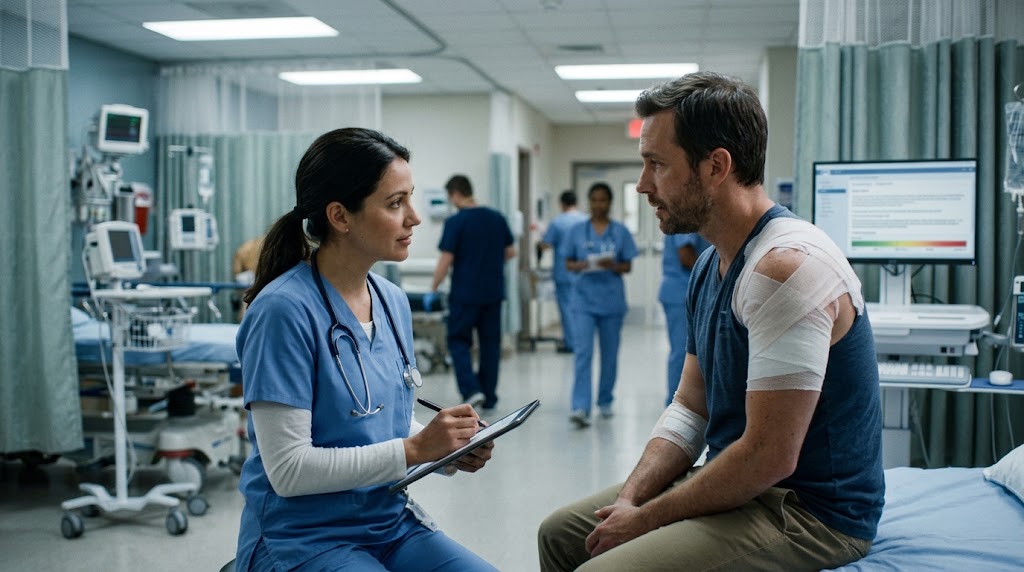
About 43 million people a year arrive at US emergency rooms with injuries, and more than a quarter of them later develop post-traumatic stress disorder. Most are never screened for it, because emergency staff have only minutes per patient. Researchers at NYU Langone Health recorded how 145 injured patients answered one routine intake question, what brought them to the emergency room, and had a set of AI models analyze their words. A month later, clinicians assessed who had developed PTSD.
The AI tool, called PREVIA, correctly identified more than 95.4% of the patients who were at risk. In a head-to-head test on 30 patients who went on to develop PTSD, it flagged all 30, while an emergency clinician who specializes in PTSD correctly identified 89% of them.
“This is the first study to show that a patient’s spontaneous answers to a single, routine care question, ‘What brought you to the ED?’, carries enough of a psychological signal to forecast their PTSD risk a month later,” said senior author Katharina Schultebraucks, an associate professor of psychiatry and population health at NYU Langone.
The tool listens for specific signals in how people describe what happened. Its first layer looks for signs during the trauma itself, such as a sense of losing control or gaps in memory, and early symptoms in the emergency room, such as feeling disconnected from one’s own body. A second layer weighs risk factors like earlier mental health problems and lower income against protective ones like coping skills and strong social support.
A third model combines those assessments into a structured summary, and a final step adds age, sex, the type of trauma and known PTSD rates to produce a risk score with a plain-language explanation. Different AI models were used for different jobs: one tended to emphasize warning signs, another protective factors, so no single model dominated.
The predictions were checked against the gold-standard clinical interview for PTSD, done by trained clinicians a month after the injury.
The second finding is about why this matters. Only about 28% of US emergency departments routinely screen for PTSD, and only two-thirds of those use validated questionnaires, largely because staff typically have 15 to 20 minutes per patient. The first month after a trauma is a key window, because many patients have no further contact with the hospital after that.
“We built PREVIA on open-source models with no training or fine-tuning required,” Schultebraucks said. “That means other hospitals can test it independently, without access to proprietary software or our patient data, which is essential for widespread adoption.” AI tools in emergency care can also carry risks, as a study of AI triage and stigmatizing labels found, and AI is increasingly used to read what people say about their health, as with an analysis of Reddit posts about a weight-loss drug.
For anyone who has been through a frightening injury, the takeaway is not about AI. Symptoms like reliving the event, avoiding reminders of it, sleep problems or feeling on edge in the weeks afterward are common, and early help works best. Talking to a doctor or mental health professional in the first month is worth it.
There are limits to what this shows. With 145 patients, and only 30 in the head-to-head comparison, the study was small, and the tool has not been tested in other hospitals or populations. A perfect score on 30 cases may not hold up in a larger group, and the study does not report how many people without PTSD were wrongly flagged. The study was funded by the US National Institute of Mental Health.
Source
“PREVIA: A Clinically-Informed LLM Ensemble for Early PTSD Risk Prediction from ED Trauma Narratives.” Nature Communications, 2026.
DOI: ADD-DOI-HERE