A study of 3.7 million children found that one common hospital scan was linked to a higher brain tumor risk. In absolute terms, the risk stayed small

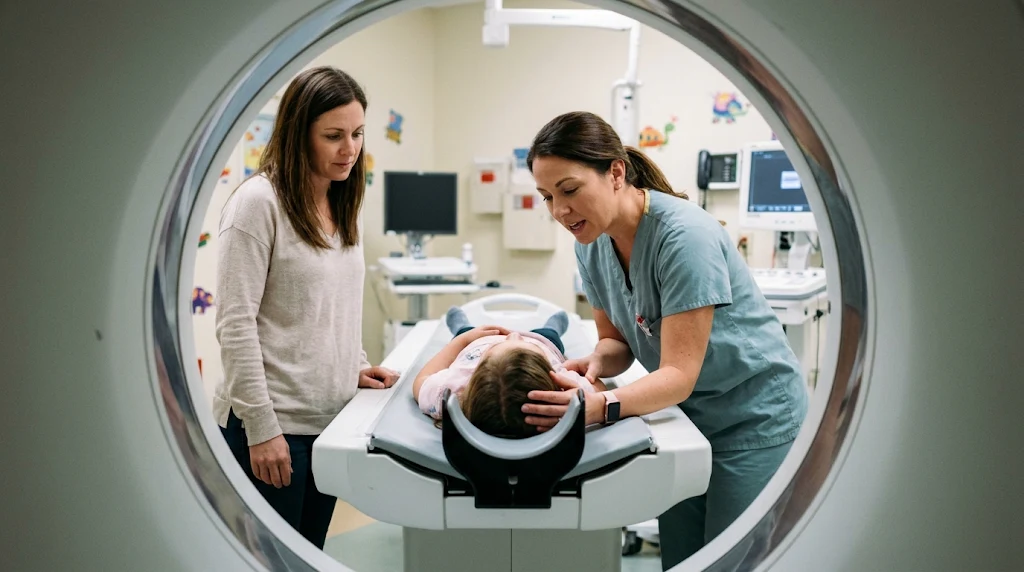
The head is the body part doctors scan most often in children, usually after a fall or a knock in the playground. Some of those scans use ionizing radiation, and a head CT delivers far more of it to the brain than an ordinary X-ray. Researchers at UC Davis and UC San Francisco followed more than 3.7 million children in the US and Ontario, Canada, from birth for an average of 12 years, adding up every scan each child received.
Radiation equal to a single head CT was linked to a 1.8-fold higher risk of a brain tumor. The risk rose as the dose added up, and the link was stronger for aggressive tumors.
In absolute terms the risk stays small. The researchers estimate about 8 extra brain tumors for every 10,000 children by age 21, or roughly one extra tumor for every 1,266 head CT scans.
“The study found that the risk of a brain tumor remains small in children exposed to ionizing radiation from medical imaging; however, risk increased with higher radiation exposure,” said first author Diana Miglioretti, a professor and chief of biostatistics at UC Davis Health.
Across the whole group, 1,536 children were diagnosed with a brain tumor. Most were diagnosed between ages 2 and 10, and 82.5% of the tumors were classified as aggressive. The researchers estimate that about 10.1% of brain tumors in children and teenagers may be due to radiation from medical imaging.
Head CT scans were not rare. In the full group, 4.3% of children had one head CT, 0.9% had two, and 0.4% had three or more. The team used electronic medical records to estimate each child’s total brain dose from all imaging that uses radiation, including X-rays, CT, PET, fluoroscopy and nuclear medicine.
The study was published in JAMA and funded by the National Cancer Institute.
Children are more sensitive to radiation than adults because their tissues are still growing, and they have more years ahead for a cancer to develop. Concern about CT scans in children has been raised for years, and this study adds one of the largest datasets so far.
None of this means a child who needs a scan should go without one. “Our findings do not mean that parents should avoid getting their children medically necessary imaging,” Miglioretti said.
“Head CT is invaluable in the right setting, such as to assess for bleeding after severe trauma,” said senior author Rebecca Smith-Bindman, a radiologist and professor at UCSF. “More judicious use of head CT and ensuring the doses for every exam are as low as possible will reduce this harm.”
For parents, the practical step is to ask questions when a scan is suggested after a minor head bump. Doctors in emergency departments have validated decision rules, known as PECARN, designed to identify which children with head injuries actually need a CT. It is reasonable to ask whether the scan is needed, whether observation or a scan without radiation such as MRI or ultrasound would work, and whether the dose has been adjusted for a child.
Recent research has looked hard at what helps children and what does not. A trial we covered tested the classroom accommodations schools give kids with ADHD, and another analysis found strength training eased depression across 80 trials.
There are limits. The study is observational, so it shows a link, not proof that the radiation caused the tumors. Children who need repeated scans may differ from others in ways that also affect tumor risk, such as an underlying condition. Doses were estimated from records rather than measured for each child. The press release does not describe the study’s limitations in detail, so readers should check the full paper for them.
Source
Miglioretti DL, Smith-Bindman R, et al. “Medical Imaging and Pediatric and Adolescent Brain Tumor Risk.” JAMA, 2026.
DOI: 10.1001/jama.2026.20441