Almost everyone has jolted awake just as they were falling asleep, and people who do it every week tended to have something else in common

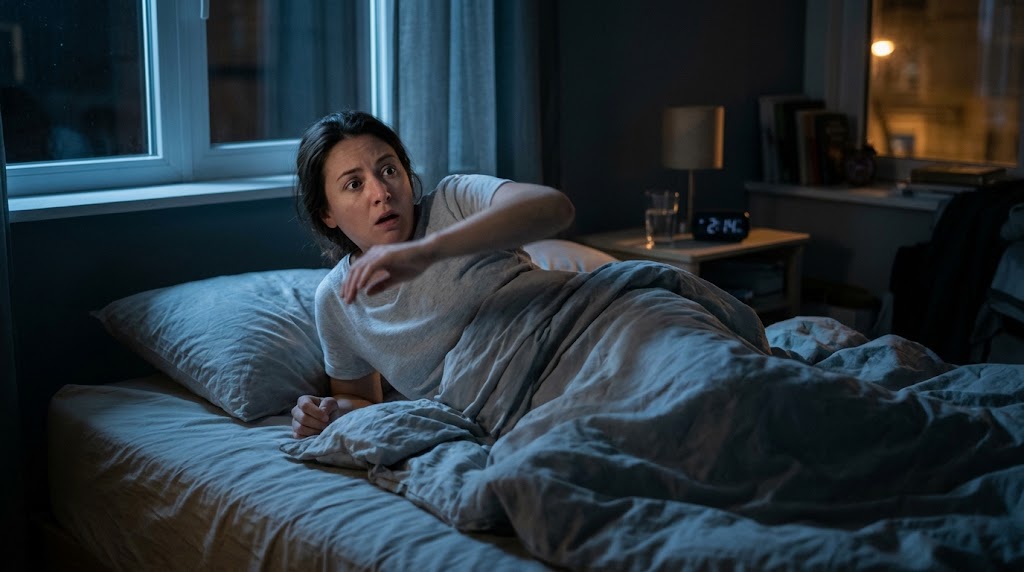
Most people have felt it: just as you drift off, your body jerks, you feel like you are falling, and you are suddenly wide awake with your heart racing. These moments are called sleep starts, or hypnic jerks. Researchers at Paris Lodron University Salzburg in Austria surveyed 194 adults in Austria and Germany, comparing 96 who experience sleep starts at least weekly with 98 who rarely or never do. They asked about sleep quality, insomnia, beliefs about sleep, anxiety and depression.
People who had sleep starts every week reported poorer sleep quality, more severe insomnia, more unhelpful beliefs about sleep, and higher levels of anxiety and depressive symptoms than people who rarely had them. All of those differences were statistically significant.
How often sleep starts happened tracked most closely with anxiety, sleep quality and beliefs about sleep, but not with depression. Together with age and gender, those factors explained about a quarter of the differences between people in how often they jolted awake.
Sleep starts turned out to be more than a twitch. Participants described sensations of falling, electric-shock feelings, tingling, flashes of light, loud bangs and brief dream-like images, often with a rush of alarm or fear and a racing heart.
“Sleep starts are much more than a simple muscle twitch when falling asleep,” said first author Tanja Grünberger. “Participants described not only jerks, but also sensations of falling, a racing heart, flashes of light or loud bangs, and strong feelings of alarm or fear.”
The second finding is about stress. Participants said their sleep starts came more often during periods of psychological stress and emotional strain, while being short on sleep seemed to matter less. Many described a strong pressure to finally fall asleep in the moment itself.
“The more strongly participants held unhelpful beliefs about sleep and the more anxious they were, the more often they reported sleep starts,” Grünberger said. “Our data cannot show what causes what, but this pattern resembles what we know from insomnia.”
The researchers suggest thinking of frequent sleep starts as part of hyperarousal, a state in which the body and mind stay too alert to let go into sleep. That idea already guides treatments for insomnia, such as cognitive behavioral therapy, which target worry about sleep. What happens as we fall asleep and during deep sleep matters for the brain in other ways too, as research on deep-sleep brain waves and memory and sleep and brain health has shown.
“For most people, sleep starts are a harmless feature of falling asleep,” said senior author Manuel Schabus. “For a subgroup, however, they go along with distress and a longer time to fall asleep.” For people in that group, relaxation before bed, less pressure to fall asleep quickly, and talking to a doctor about persistent insomnia or anxiety are reasonable steps, though the researchers say they have not yet been tested specifically for sleep starts. Anxiety and depression have effective treatments, as a recent comparison of antidepressants shows.
There are limits to what this shows. The study was a small online survey at one point in time, so it cannot show whether anxiety causes sleep starts or the other way around. There is no established questionnaire for sleep starts, so the team wrote its own questions, and there were no sleep recordings. The authors received no specific funding and declared no competing interests.
Source
Grünberger T, Höhn C, Schabus M, Laireiter A-R. “Sleep starts: Phenomenology and associations with sleep, psychological, and demographic characteristics.” PLOS Mental Health, 2026.
DOI: 10.1371/journal.pmen.0000737