Adults with type 2 diabetes did the same 70-minute workout in opposite orders for 8 weeks. Only one order significantly lowered their average blood sugar

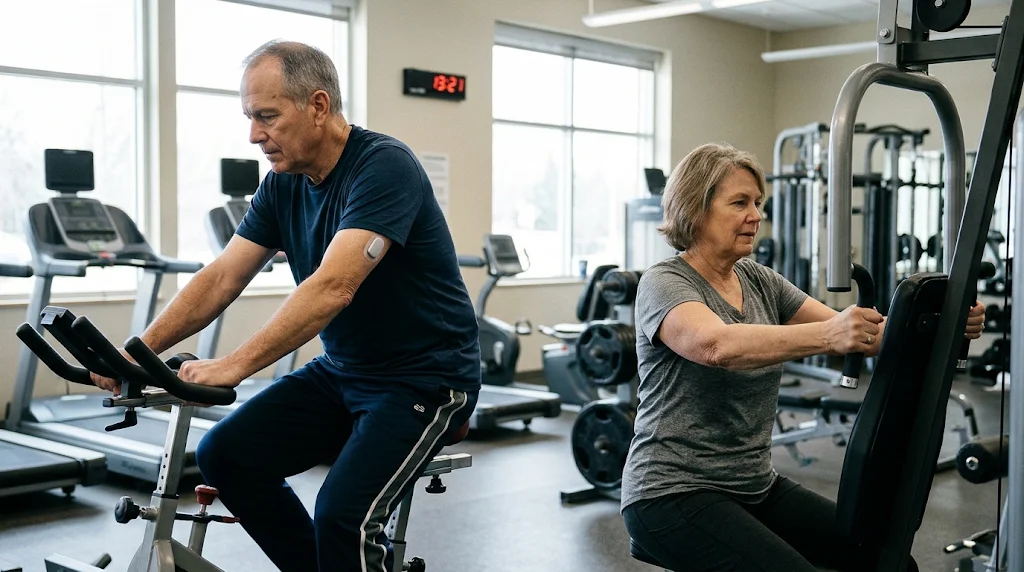
Most diabetes guidelines recommend combining cardio with strength training, but they say nothing about which should come first. Researchers in Nanjing, China, randomly assigned 56 adults with type 2 diabetes to the same 70-minute workout three times a week for eight weeks. Half cycled for 30 minutes and then lifted weights for 30 minutes, the other half did it in reverse, and everyone wore a continuous glucose monitor.
Only the cardio-first order significantly lowered average blood sugar. In that group, mean glucose on the monitors fell from 8.7 to 8.2 mmol/L (about 157 to 148 mg/dL), and HbA1c, the measure of blood sugar over the previous two to three months, dropped by 0.3 percentage points from a starting level of 7.6%. In the weights-first group, average glucose did not improve, moving from 8.1 to 8.4 mmol/L, a change that was not statistically significant. At the end of the trial, average glucose was significantly better in the cardio-first group than in the weights-first group.
The clearest difference appeared at night. On days without exercise, between midnight and 6 a.m., glucose levels in the cardio-first group fell by about 10.7%, while the weights-first group saw essentially no change. The researchers listed this overnight effect among the trial’s main findings.
The weights-first order had its own advantage. Blood sugar swings, measured as the coefficient of variation, rose in the cardio-first group from 24.1% to 26.1% but stayed flat in the weights-first group. In other words, cardio-first brought the average down but made glucose a little more up and down, while weights-first kept it steadier. Both orders cut fasting insulin among the 44 participants who did not use insulin.
The workouts were moderate and supervised. Cycling was done at 40 to 70% of heart rate reserve, roughly moderate to vigorous effort, and the strength session used machines at 60 to 80% of each person’s one-repetition maximum, with sets of 10 to 12 reps. Participants averaged 62 years old, had lived with diabetes for about nine years, and had not exercised regularly before. They attended about 80% of sessions.
The researchers, led by Xiao Tan of Zhejiang University School of Medicine and Karolinska Institutet, did not declare a winner. “Clinical selection of exercise sequence should be individualized based on patient priorities,” they wrote. Someone whose main problem is high average or overnight glucose might start with cardio, while someone prone to big swings might start with weights.
For anyone with type 2 diabetes, the bigger message is that both orders helped, and that doing the combined workout matters far more than the sequence. Changing the order costs nothing, though, and is easy to try with a glucose monitor. Anyone on insulin or drugs that can cause low blood sugar should talk to their doctor before changing an exercise routine. For more on how timing affects health, see what happened to people who ate their first meal after noon, and for the mental side of lifting, the strength training and depression analysis.
The trial has clear limits. It was small, with 28 people per group, and ran for only eight weeks, which the authors say may have been too short to see an effect in the weights-first group. The difference in HbA1c between the two groups was not statistically significant, only the drop within the cardio-first group was. Meals were not recorded, workout times were not standardized, and participants had a lower average BMI, 24.5, than is typical for people with type 2 diabetes in many countries, so results may differ in heavier patients.
Source
Zhao Y, Zha Y, Chen B, Jia Y, Chen Y, Zhang Z, Wei L, Sun Z, Tan X. “Sequence of aerobic and resistance exercise influences short- and long-term glycemic control in type 2 diabetes: A randomized trial.” iScience, 2026; 29(11): 118041.
DOI: 10.1016/j.isci.2026.118041