Making daylight saving time permanent would send American kids to school in the dark at least 2 billion more times a year, and that comes with a cost

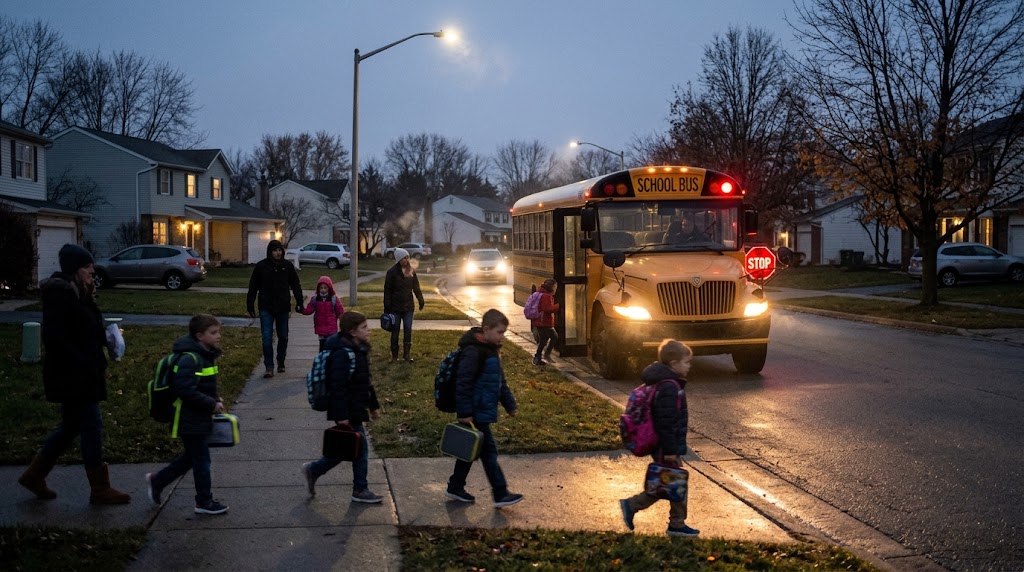
Every November, Americans set their clocks back an hour, and every year the debate returns about ending the switch for good. The US House has passed a bill to make daylight saving time permanent, and 19 states have approved similar measures. Researchers at the University of Washington looked at what that would mean for one group in particular: children going to school. Using enrollment, start times and school locations, they counted how many trips to school would happen before sunrise.
Permanent daylight saving time would add at least 2 billion school commutes in the dark across the United States each year compared with the current system of changing the clocks twice a year. And the researchers think that figure is an underestimate.
The reason it matters: an analysis of US traffic records found that fatal crashes involving school-aged pedestrians were roughly twice as likely to happen on dark mornings as after sunrise.
“It’s called the ‘Sunshine Protection Act’ because you get an extra hour of light at the end of the day. But you will take that hour from the morning. You could call it the Sunshine Destruction Act,” said senior author Horacio de la Iglesia, a professor of biology at the University of Washington. “Nobody wants their kids to go to school in the dark.”
The team examined 14 of the 19 states that have approved permanent daylight saving time measures in detail. In Washington state alone, the change would add nearly 35 million dark school commutes a year. Georgia would see the biggest increase, about 71 million. In Mississippi and Alabama, where schools start on average before 8 a.m., dark trips would jump from about 2 million to more than 20 million per state.
The national estimate assumed children leave home around 8 a.m. Because many leave earlier, especially those who catch early buses or eat breakfast at school, the real number is likely higher. “That’s pretty late, so our calculation is likely an underestimation of the real number,” said lead author Guadalupe Rodríguez Ferrante.
Sleep scientists have warned about this for years. In 2020, the American Academy of Sleep Medicine published a position statement in the Journal of Clinical Sleep Medicine calling for permanent standard time rather than permanent daylight saving time, because standard time better matches the body’s internal clock.
The second finding is about morning light itself. Bright light early in the day helps set the circadian clock that governs sleep, mood and appetite. Teenagers’ body clocks already run late, and dark mornings would push them later still, undoing some of the benefits of later high school start times that many districts have adopted.
Could schools just start later? De la Iglesia argues that would ripple outward. “If we do that, you will end up going to work later. And everything is going to get delayed,” he said. “And essentially, we’re just going to be realigning everybody to solar time. That, by definition, is Standard Time.”
For families, the findings are a reminder that morning light is worth protecting: a walk to school or time outside before class when it is light helps set children’s sleep for the night ahead. Daylight shows up again and again in health research, from dementia risk in adults to how sleep protects the brain.
There are limits to what this shows. The study counts dark commutes and links dark mornings to crash risk, but it does not measure how many crashes permanent daylight saving time would actually cause. The national figure relies on broad assumptions, and schools could adjust their schedules. The researchers took no position on clock changes beyond the evidence in the paper.
Source
Rodríguez Ferrante G, Dasika NS, Nam A, et al. “Over a billion more dark-morning school commutes for K–12 children under the Sunshine Protection Act.” Current Biology, 2026.
DOI: 10.1016/j.cub.2026.10.014
Also cited
Rishi MA, Ahmed O, Barrantes Perez JH, et al. “Daylight saving time: an American Academy of Sleep Medicine position statement.” Journal of Clinical Sleep Medicine, 2020.
DOI: 10.5664/jcsm.8780